02 – Investigating how Civil Infrastructure can Adapt to an Increasingly Extreme Climate
INTRODUCTION
Most civil infrastructure is designed to remain operational for long periods of time, meaning structures solely designed using limited historical data may experience a vastly different set of conditions in its lifetime. This introduces uncertainty as engineers aim to design for an unpredictable future climate.
Climate change is expected to increase the frequency and intensity of extreme rainfall events, which creates challenges for flood-sensitive infrastructure such as dams. In the past, engineers have simply designed dams with existing historical data, but can this weather data reliably tell us what to design for the future?
I explored this engineering problem by using 95 years of historical rainfall observations and Extreme Value Theory (EVT) to estimate the magnitude of an extreme event. I then investigated Tunstall reservoir as a real example of vulnerability in infrastructure that was not designed for climate change, and analysed how existing and future infrastructure could be made more resilient.
WHY IS THIS IMPORTANT?
Dams built decades ago were designed using the standards and data available at the time. However, the statistical distribution of rainfall can change over time. A reliable set of historical conditions may not necessarily be extrapolated to guarantee future conditions.
In this poster I am trying to predict the magnitude of a 1-in-1000-year rainfall event:
This event has 0.1% probability of exceedance in any given year; however it does not follow that one event occurs exactly every 1000 years.
It follows that if a dam is built for a 100-year lifespan, there is a 1 in 10 chance it will experience a 1000-year event.
There is 95 years-worth of reliable rainfall data, yet predictions must be made hundreds of years into the future. To do this, engineers use Extreme Value Theory, Generalised Extreme Value distributions, and Maximum Likelihood Estimation.
FINDINGS
For my data, I used the Met Office HadNEEP daily rainfall dataset for North East England. I extracted the daily maximum each year until I had 95 data points.
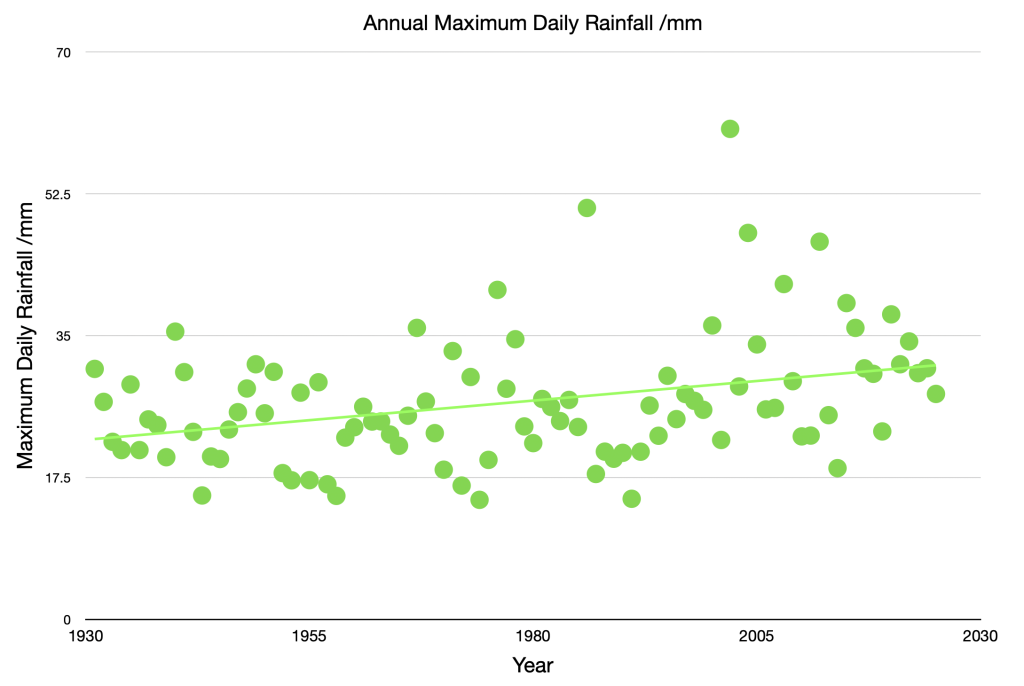
While I do have some reliable data, I am aiming to predict something much rarer than any data point I currently have.
I can now fit the data to a Generalised Extreme Value (GEV) distribution. This has three parameters: 𝜇, 𝜎 and 𝜉. Each one describes some property of the data.
These parameters are combined such that:
Therefore, I can use the date to determine the values of 𝜇, 𝜎 and 𝜉, and then solve for F(x) = 0.999. This will allow me to find the value of 𝑥₁₀₀₀.
I used python to write a code that would calculate this, and found these values to be most plausible:
Magnitude of 1000-year event (𝑥₁₀₀₀) = 69.3mm
But: there is a problem with this result. I have used 95 years-worth of data to predict 1000 years into the future, extrapolating well beyond the observations. This introduces extreme levels of uncertainty. As a result of this, the best thing to do is produce a confidence interval. I used a program on MetricGate for Maximum Likelihood Estimation (MLE) , which gave:
This means that with 95% confidence I can say that the magnitude of the 1000-year event is no greater than 81.3mm, and hence design a dam to withstand 81.3 mm of heavy rainfall. This provides a framework for improved safety in modern infrastructure, and guidelines for improving existing infrastructure.
This is the current most popular method for estimating extreme values, but it has a major flaw. Extreme Value Theory does not necessarily account for climate change. There is a real need for an updated estimation system in order to improve the safety of infrastructure as the earth’s climate becomes much more extreme.
Side Note: Another possible method would be to use Bayesian Extreme Value Analysis. Bayesian methods could incorporate both uncertainty and a changing climate into the fitted model parameters and produce a range of plausible extreme rainfall predictions. It is too complicated to include in this poster, but is a very real possibility for how scientists and engineers may incorporate climate change into their predictions in the future.
CASE STUDY: BALDERHEAD RESERVOIR
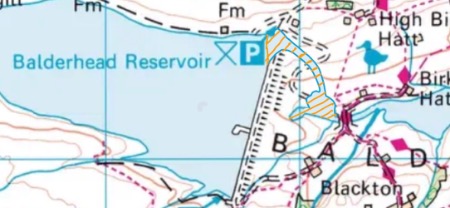
I applied my estimate to Balderhead Reservoir, a large earth embankment dam in County Durham built in 1964. This is a theoretical situation where the regional rainfall estimate falls uniformly across its 20.8km² catchment. In a worst-case scenario, the ground is already saturated, giving a runoff coefficient of 0.9.
This water must either be stored or discharged safely. Increased inflow raises the risk of overtopping and erosion of the downstream embankment. Extreme conditions can also increase pore-water pressure, reducing effective stress:
This reduces resistance to shearing and can contribute to slip failure. More information is needed to determine whether Balderhead specifically would fail under these conditions, but under this extreme of a rainfall event it is possible.
Proposed design improvements: I propose an auxiliary spillway that activates when water levels exceed the capacity of the existing tunnel spillway. If the runoff enters over 24 hours, the average inflow is approximately 15 m³s⁻¹. Using an estimated rainfall intensity of 10 mmh⁻¹ gives a simplified peak flow of about 52 m³s⁻¹. Assuming the existing spillway can safely discharge 30 m³s⁻¹, the auxiliary spillway would carry approximately 22 m³s⁻¹. Using a simplified broad-crested weir model:
The spillway would curve around the dam before rejoining the river and include an inlet, erosion-resistant chute, stilling basin and return channel. This is only an initial proposal; a real design would require a much larger operation.
CONCLUSION
Climate change is making it increasingly important to design resilient and sustainable infrastructure, built for conditions more extreme than anything recorded historically. Designs must allow for uncertainty through safety margins and adaptable designs, while prioritising the targeted strengthening of existing, outdated designs. As more accurate statistical models evolve, including the possibility of a Bayesian model that factors in a ‘climate change’ variable, engineers must continually adapt to new data and our developing understanding of uncertainty in extreme events. Ultimately, the challenge is to create infrastructure that remains safe and effective across a range of uncertain future conditions.