Deploying Depth is a personal engineering research and design project exploring the application of origami-derived geometry to deployable structural systems. The project explores complex engineering constraints, kinematics, and the behaviour of structures relevant to civil, mechanical and marine engineering.
In a densely populated and increasingly volatile world, with natural disasters climbing in frequency and severity, it has never been more critical for civil engineers to design infrastructure that can withstand both the wrath of nature and that of man.
However, the importance of post-disaster structures cannot be underestimated. When existing infrastructure fails, temporary fixes must be implemented to restore vital access to the areas affected.
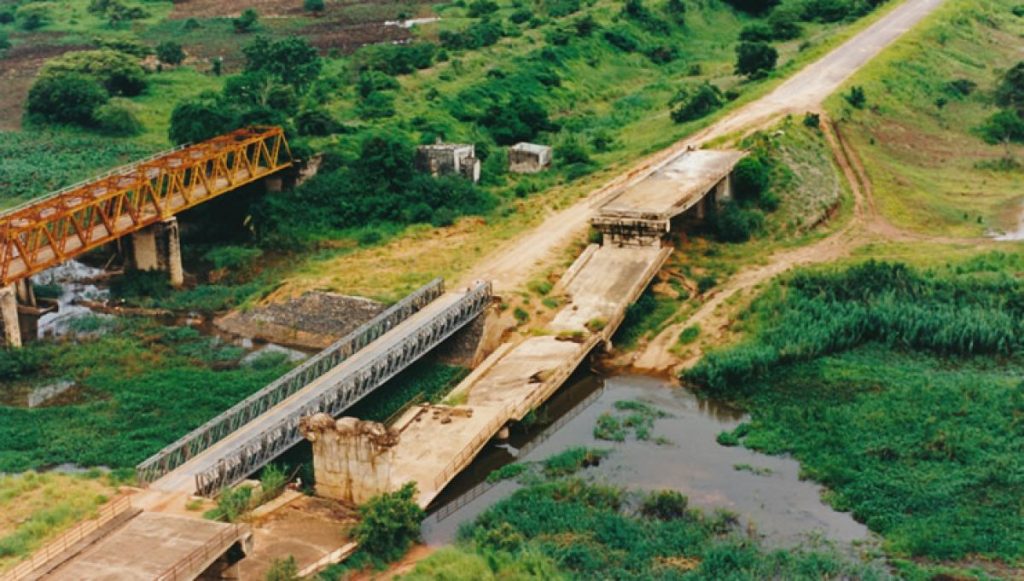
I am particularly interested in portable bridge structures, and how these can be used to provide access to disaster zones. I hope to explore how these can be improved to handle larger scale and more frequent disasters, researching existing solutions and evaluating the best approach to designing this kind of structure.
In this research I will explore several case studies to contextualise the use of temporary infrastructure in affected areas. I will look at the solutions that are readily available and evaluate the effectiveness of each.
My Goal
My intention is to explore this topic and come up with my own solution to this problem. I have a particular interest in the mathematics of origami and folding, and I would like to use this as a background when beginning to solve this problem
I aim to investigate whether origami-inspired folded structures can provide sufficient stiffness and load-bearing capacity for rapidly deployable temporary pedestrian bridges in disaster-relief scenarios. I will discuss two types of origami fold and how they compare to flat sheets.
This project is intended as preparation for a career in engineering, with a focus on structural and mechanical systems.